AI Search Is Changing the Role of Websites — Here’s What Businesses Need to Understand
For years, the internet worked in a fairly predictable way.
- Someone searched for a question on Google.
- They clicked a link.
- They browsed a website to find the answer.
That model is now changing.
AI search tools — including Google’s AI Overviews, ChatGPT, Perplexity and others — are increasingly answering questions directly inside the search experience.
In many cases, users get what they need without clicking through to a website at all.
At first glance, this sounds like bad news for websites.
But the reality is more nuanced. And for many businesses, the change may actually make their website more important — not less.
Let’s look at why.
The Traditional Search Model
Historically, the search journey looked like this:
- Someone searches for a question
- Google lists links to relevant websites
- The user visits multiple sites
- They compare options and eventually make a decision
In this model, websites served two roles:
- Answering questions
- Converting visitors into enquiries or sales
Much of SEO was focused on capturing traffic from informational searches.
If someone searched “how much does solar cost?”, the goal was to appear in the results and attract the click.
But AI search tools are changing this behaviour.
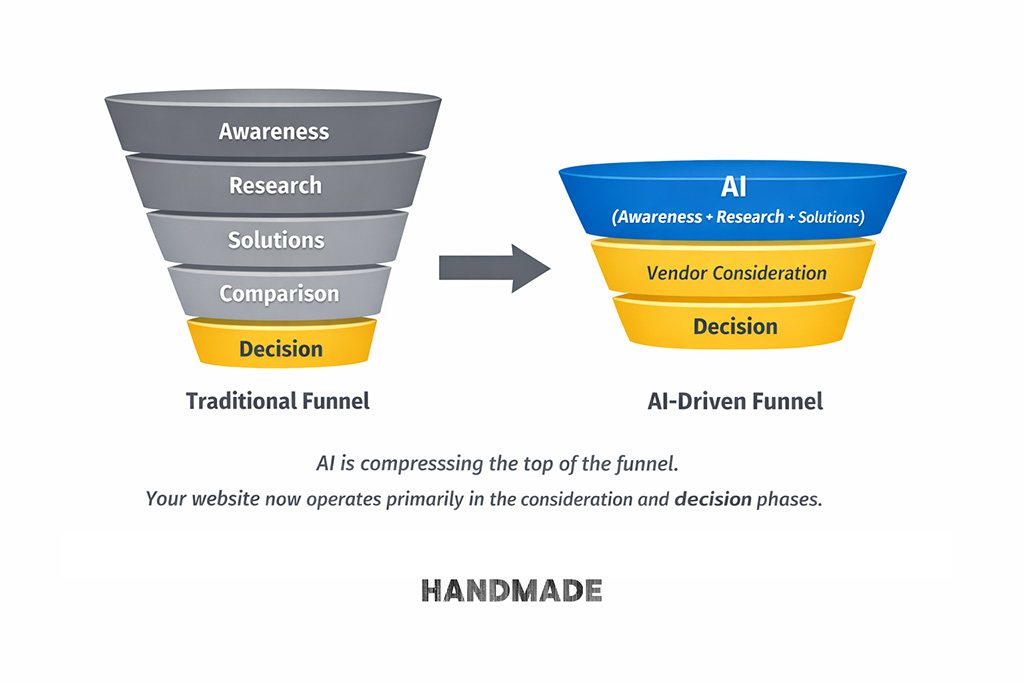
AI Is Compressing the Buying Journey
AI systems are becoming very good at summarising information.
Instead of showing ten links and asking users to figure it out themselves, AI search engines often provide a complete answer immediately.
For example, someone might ask:
“How much does a solar battery cost in Australia?”
Instead of sending them to multiple websites, the AI may produce a summary explaining typical price ranges, system sizes and rebates.
The result?
Fewer exploratory clicks.
People may visit fewer websites during the research phase because the AI has already summarised the landscape.
But something interesting happens next.
When someone does click through to a website, they are often much further along in the decision process.
The Traffic That Remains Is More Intentional
In the past, many website visitors were early-stage researchers.
They were gathering information, comparing ideas, and still forming their understanding of the problem.
Now, AI tools are increasingly handling that stage.
So by the time someone arrives on a website, they may already know:
- What the product category is
- Rough pricing expectations
- Which brands or solutions exist
- What questions to ask
In other words, the visitor arrives more informed.
This means the role of the website is shifting from:
information discovery → decision validation.
People are visiting fewer websites — but when they do, they are often serious prospects.
Websites Are Becoming Trust Platforms
Because AI tools summarise information, users increasingly rely on websites for something different:
proof.
They want to confirm that the company behind the product or service is credible.
When someone lands on a site today, they are often looking for signals such as:
- Professional design and usability
- Clear explanations of services or products
- Evidence of experience and expertise
- Testimonials, case studies or reviews
- Local credibility and contact information
The website becomes the place where people answer the final question:
“Is this a business I trust?”
This makes design, content quality and messaging more important than ever.
Generic Content Will Struggle
Another consequence of AI search is that generic informational content becomes less valuable.
If an AI can summarise the basics instantly, users don’t need to read five blog posts explaining the same thing.
This means businesses need to focus more on:
- Original insights
- Real experience
- Case studies
- Expert commentary
- Clear explanations of their own approach
Content that simply repeats what everyone else says is unlikely to attract much attention — from users or from AI systems.
What Businesses Should Do Now
The rise of AI search doesn’t mean websites are becoming obsolete.
It means their role is evolving.
Businesses that adapt will likely benefit from more qualified enquiries.
A few practical steps include:
1. Strengthen your credibility signals
Make sure your website clearly demonstrates expertise, experience and trustworthiness.
2. Focus on decision-stage content
Instead of only writing “what is…” articles, create content that helps people choose between options.
3. Invest in good design and usability
When visitors arrive, the experience should immediately feel professional and easy to navigate.
4. Publish real insights
Share practical knowledge from your work — not just generic information.
The Bottom Line
AI search tools are changing how people discover information online.
Some website traffic will inevitably decline as AI answers basic questions directly.
But the visitors who do arrive are likely to be better informed and closer to making a decision.
For businesses, this means the goal of a website is shifting.
It’s no longer just about attracting clicks.
It’s about earning trust at the moment someone is ready to choose.
And in that role, the website remains one of the most important assets a business can have.
